The Algorithm Whisperers: How Soviet Math Culture Built Silicon Valley's AI Backbone
The Room Where It Happens (And Who's In It)
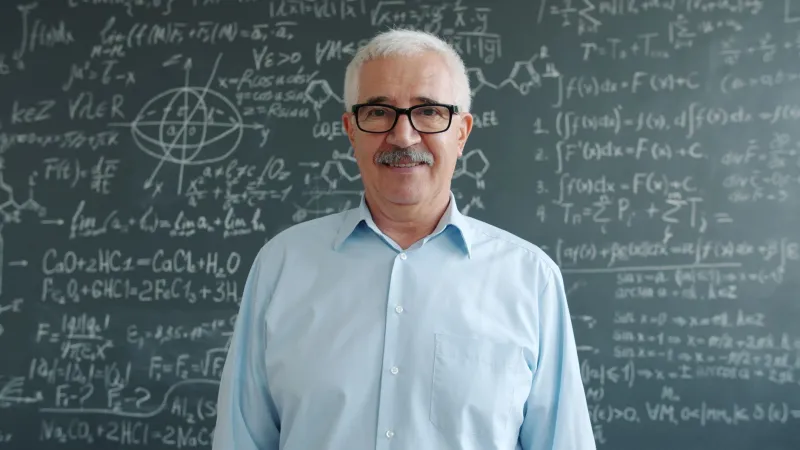
Picture a typical ML team meeting at a mid-to-large AI company in San Francisco. Someone's walking through a gradient descent optimization problem on a whiteboard. Odds are decent that the person holding the marker has a last name ending in "-ov," "-sky," or "-enko." This isn't anecdotal hand-waving — LinkedIn data, conference speaker rosters at NeurIPS and ICML, and team pages at companies like Google DeepMind, OpenAI, and Meta AI tell a pretty consistent story: engineers from Russia and the broader Eastern European region are punching well above their demographic weight in AI and machine learning roles.
So what's actually going on here? Is it a recruiting pipeline thing? A cultural artifact? Or something baked deeper into how certain countries decided to treat math education?
Spoiler: it's all three, and they're impossible to untangle.
The Olympiad Factory
If you grew up in the US, your relationship with competitive math probably peaked at a regional Science Olympiad or maybe a state-level AMC exam. Respectable, sure. But in the Soviet Union — and in its successor states that inherited the educational infrastructure — mathematical olympiads weren't extracurricular enrichment. They were a pipeline to power.
The system worked like this: gifted students were identified early, funneled into specialized "physmath" schools (физико-математические школы), and trained with an intensity that would make most American STEM programs blush. The curriculum wasn't just about getting the right answer — it was about developing what Russian educators called математическая культура, or mathematical culture: an instinct for elegance, a distrust of brute-force solutions, and a deep comfort with abstraction.
This tradition produced the International Mathematical Olympiad circuit, where Soviet and post-Soviet teams dominated for decades. More practically, it produced generations of people who look at a messy real-world problem and immediately start asking: what's the underlying structure here? What can I prove? Where are the invariants?
That's basically the job description for an ML researcher.
When the Wall Came Down, the Engineers Came West
The 1990s were economically brutal for most of the former Soviet Union. Science and engineering salaries collapsed. Entire research institutes shuttered. But the human capital those institutions had built didn't disappear — it migrated.
The first wave hit US universities hard and fast. Graduate programs in math, computer science, and physics saw a surge of exceptionally prepared applicants from Russia, Ukraine, Belarus, and the Baltics. Faculty advisors at places like MIT, Stanford, and Carnegie Mellon started noticing that these students weren't just technically solid — they had a different relationship with hard problems. Less intimidated by them. More willing to sit with difficulty.
"They'd been trained to think that struggling with a problem for weeks was normal," one Stanford CS professor told a colleague in a story that's been retold enough times in the Valley to feel almost mythological. "American students sometimes expected an answer to emerge quickly or concluded they were on the wrong track. These guys just... kept going."
That cohort got their PhDs, entered the industry in the early 2000s, and by the time the deep learning wave hit around 2012, many were already in senior positions — exactly where you want to be when a new paradigm blows everything up.
The Visa Maze Nobody Talks About
Here's where the story gets less triumphant and more complicated. For every Russian or Ukrainian engineer thriving at a Bay Area AI lab, there are likely several more who navigated a genuinely punishing immigration process to get there — or who gave up and took their skills elsewhere.
The H-1B lottery system is a blunt instrument. It's designed without much consideration for the difference between a median software hire and a researcher who spent fifteen years developing expertise in a narrow but critical subfield. Companies with resources — your Googles, your Metas — can absorb the legal costs and sponsor green cards aggressively. Startups often can't, which means they lose access to exactly the kind of specialized talent that could define their technical direction.
Post-2016 policy shifts made the process even more unpredictable. Engineers who'd built careers, bought homes, and raised kids in the US found themselves in bureaucratic limbo. Some left for Canada, which has been frankly more strategic about attracting this demographic. Toronto and Vancouver didn't become AI hubs by accident — they got there partly by being the path of least resistance for talent the US was making feel unwelcome.
This is a genuine competitive issue, not just a human interest story.
What the Mathematical Tradition Actually Teaches
Let's get specific about what "Russian mathematical culture" actually means in practice, because it's easy to let this slide into vague admiration.
The core of it is a preference for understanding over memorization. Soviet math education, at its best, didn't want students to know that a theorem was true — it wanted them to understand why, deeply enough to reconstruct the proof from scratch if needed. This sounds obvious until you realize how much of conventional CS education is effectively teaching people to use tools without understanding what's under the hood.
In AI/ML work, this matters enormously. The difference between an engineer who can tune hyperparameters on a known architecture and one who can identify why a model is failing — and devise a novel fix — is often the difference between someone who learned procedures and someone who internalized principles.
There's also a cultural comfort with theoretical frameworks that don't have immediate applications. American tech culture, for all its virtues, has a strong bias toward shipping. "Does it work?" is often the terminal question. The tradition that produced a lot of today's AI leaders is more comfortable asking "does it work, and do we know why it works, and what does that tell us about the class of problems it belongs to?"
Those aren't opposing values — but companies that only cultivate the first one tend to find themselves surprised when their systems fail in unexpected ways.
What American Tech Culture Can Actually Learn
This isn't an argument that the US educational system is bad or that American engineers are somehow inferior. It's an observation that different educational philosophies produce different cognitive strengths, and that the current AI moment happens to reward a specific set of strengths that certain Eastern European traditions built systematically.
The practical takeaways for American companies are pretty concrete: invest in math depth, not just coding fluency. Create space for engineers to sit with hard problems longer before demanding results. Look seriously at your immigration practices — if you're losing candidates to Canadian companies because the paperwork is too painful, that's a solvable problem you're choosing not to solve.
And maybe, just maybe, reconsider the cultural assumption that struggling with a problem is a sign something's wrong. Sometimes it's a sign you picked a problem worth solving.
The engineers who built their intuitions on Soviet olympiad problems learned that lesson early. Silicon Valley is still catching up.